The Phygital Point of Service: Five Businesses, One Silent Loss
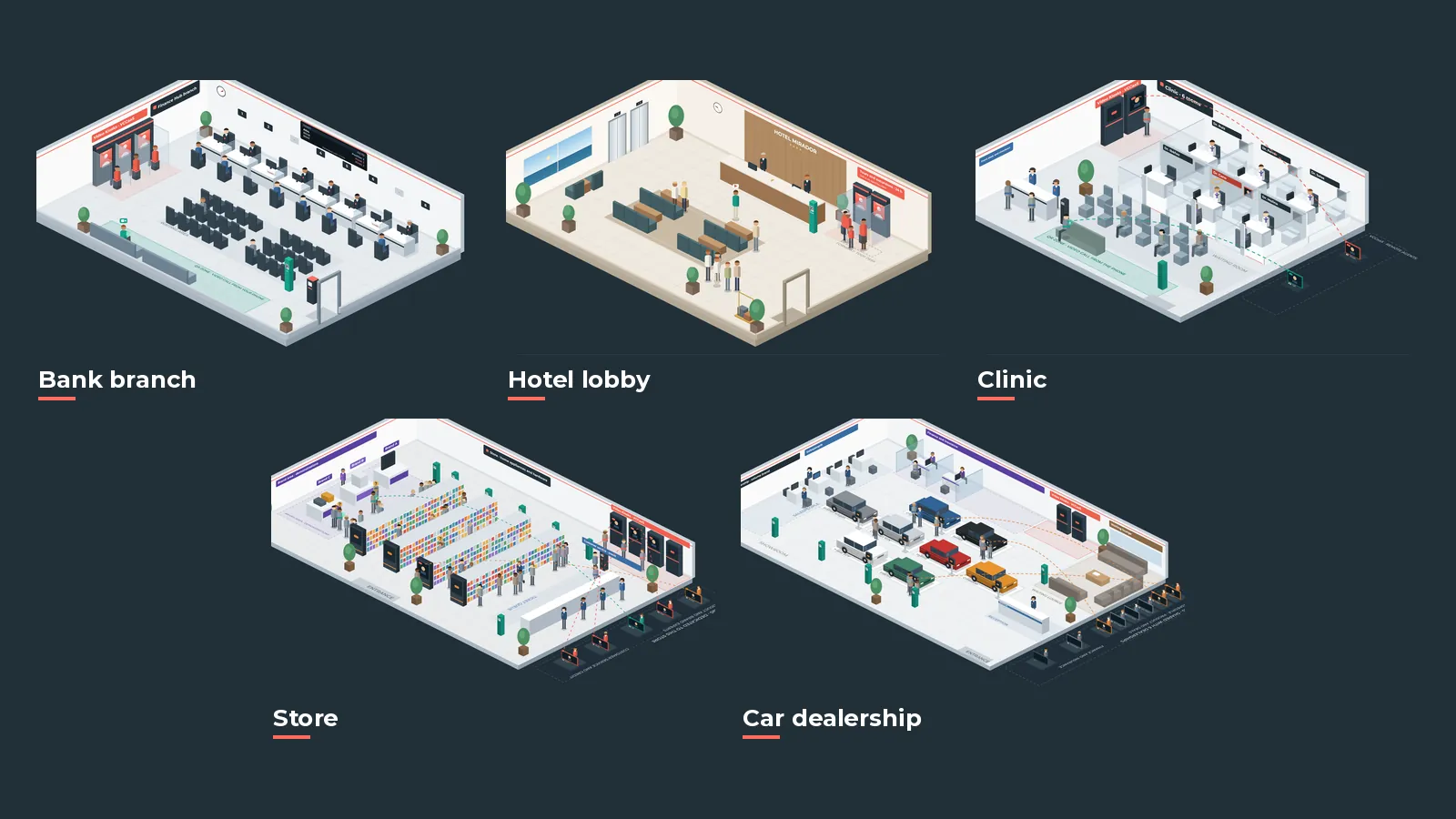
Photo source: Interactive Powers
The Phygital Point of Service: Five Businesses, One Silent Loss
The customer who leaves without being served doesn’t complain. They just don’t come back. No incident is logged, no survey is answered, and the waiting-time report still looks reasonable, because it only measures the people who stayed.
We modelled that loss in five businesses with in-person service: a bank branch, a hotel lobby, a clinic, a store and a car dealership. We took one ordinary day in each and ran the same customers through two service models: in-person only, and in-person plus Video Kiosks and QR codes served by people over video. The loss is the same everywhere. Where it happens is not.
| What is measured | In-person only | With Video Kiosks and QR | |
|---|---|---|---|
| Bank branch | Customers who leave unserved, of 240 | 28 | 7 |
| Hotel lobby | Groups wanting a tour who never talk to anyone, of 25 | 18 | 2 |
| Clinic | Callers who can’t get through, of 64 | 23 | 2 |
| Store | Requests for help left unanswered, of 457 | 93 | 24 |
| Car dealership | Buyers who leave unserved, of 49 | 10 | 0 |
The cause is the same in all five: the capacity to serve is tied to a desk, a schedule and a floor.
The branch loses 28 customers while its positions are busy only 59% of the day. The average hides the peak, and 26 of those 28 never take a ticket: they see the queue and turn around. In the clinic, each secretary is there when her doctor is, so 18 calls a day ring in an empty room. In the hotel, the tour desk opens from 9 to 2, and 12 of the 18 groups cross the lobby while it is closed. In the store, customer service resolves almost everything; people are lost in the aisle and at the brand display. At the dealership there are enough salespeople for 60 visits, but they are also on calls and follow-ups, and buyers don’t arrive evenly spread: they arrive together.
It is rarely a question of how many people there are. It is a question of where they are, and when.
What the Phygital transformation changes
- ✅ The person who serves is no longer tied to one desk: a remote team covers several sites, and one site’s peak is another’s valley
- ✅ Service reaches the customer where they are: a Video Kiosk in the branch, in the lobby, on the store floor, next to the car
- ✅ A QR code moves the same conversation to the customer’s phone when they’d rather not wait standing up
- ✅ In-person staff stay where they are; the remote team covers what they can’t reach
- ✅ There is a person on the other side: a Video Kiosk is not self-service
The economics follow the same pattern:
- Branch: the monthly result goes from 11,836 to 14,710 USD.
- Hotel: its commission goes from 3,776 to 9,084 USD a month, and the tour operator paying for the service from 131 to 2,100.
- Clinic: the time doctors spend waiting for an answer drops from 1.4 hours a day to 7 minutes.
- Store: the cost of service falls from 147,420 to 130,109 USD a month with fewer staff on the floor.
- Dealership: projected sales go from 57 to 72 a month with the same team.
How these figures were produced
A discrete-event simulation of one ordinary day per business, with the same customers in every model. The cost per interaction uses the reference rates in our report The CX Gap in Assisted Service: 13.50 USD in person and 7.16 USD remote, citing Gartner and ContactBabel (2025). Every other value is a working assumption that changes with each organisation’s data: visits, durations, staffing, hours, conversion and margins. The figures compare models; they are not a forecast.
Where this doesn’t help
In a single site with flat demand, because without a peak there is little to recover. On simple, high-volume transactions the customer is happy to complete alone, where self-service is the right and cheaper answer. And on anything that needs physical presence: a signature, an identity check, a test drive, handing over a card or a car.
Two assumptions are worth stating because they move the result. In the clinic model, a call to one consulting room is not forwarded to another; a switchboard with rollover would lose fewer calls. In the hotel, commission is set at 15%, the low end of market references; with higher commissions the operator’s margin narrows. And the model redistributes human capacity, it doesn’t create it: where specialists are scarce, sharing them helps, but it doesn’t replace hiring them.
💡 Where does your customer leave without anyone noticing, and how would you know?
👉🏻 We don’t publish these models as downloads: we run them with each organisation, on its own data. If you want to see your point of service this way, talk to our sales team.
Interactive Powers - Streamline your business communications