VIP Service by Video Call: "Don't Worry, I'll Take Care of It"
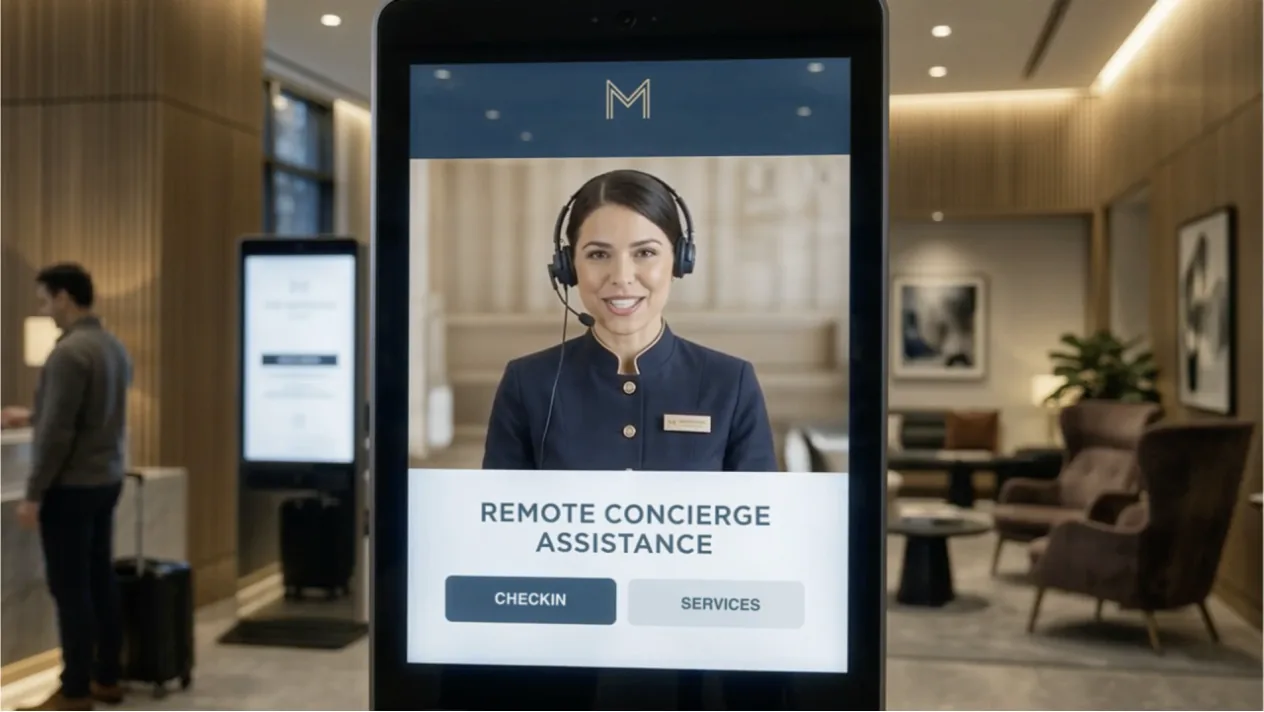
Photo source: Interactive Powers
VIP Service by Video Call: “Don’t Worry, I’ll Take Care of It”
Video calling is the channel that sectors like banking and insurance reserve for their best customers. What’s new isn’t the channel. It’s that it no longer has to be reserved for them alone.
There is never someone available in the place, and at the moment, the customer most needs it. That isn’t a staffing failure or a matter of attitude: the person who can resolve it is almost never where the problem appears, in the minute it appears. And with your best customer, that minute is everything.
Half past nine at night. A guest gets back from a congress and wants to confirm her airport transfer for the early morning and order something to eat in the room. There are two or three check-ins ahead of her: ten minutes, maybe fifteen. The kitchen closes soon. She does the arithmetic and walks past. She doesn’t ask, doesn’t complain, doesn’t say a word.
Notice what didn’t happen: no incident, no complaint, not even a queue of twenty people. Two people on the desk, and a lobby that — to whoever manages it, and to anyone looking at the operation — is running with absolute normality.
Now look at the back of the lobby. The second desk, the one selling tours and local services, has had nobody in front of it for a while. First thing in the morning it couldn’t cope; now it waits, keeping to a timetable, with a full-time resource dedicated to it. That position is overwhelmed for a few hours and empty for the rest, and both things happen every single day. It stays that way because it’s the norm — everyone does it the same.
There is no shortage of staff. What there is too much of is rigidity.
The invisible loss that erodes reputation
That guest is on a corporate rate, travels in business every month, and is one of the guests who keep the business alive midweek. She won’t leave a bad review tonight. She’ll leave a “fine” one: a 7 out of 10, a pass. The hotel will think it’s mean; to her it’s fair. And she couldn’t quite explain why.
That’s the damage. A hotel of that standing doesn’t fall on a one-star review — it erodes by accumulating “fines”. It hasn’t lost the customer. It has lost the chance to demonstrate excellence, the 9 or 10 that a service which wants to keep attracting the best guests actually lives on.
And it appears in no quality report: there is no complaint to escalate and no data point to analyse. The polite customer doesn’t protest — they simply stop rating you at the top level, even when you ask them to.
In a VIP service, excellence isn’t requested. It’s demonstrated, in how the service is defined and in how it is executed. If you have to ask someone to confirm it, you don’t have it.
The same situation, another sector
Swap the lobby for an airport, and dinner or the transfer for a premium card that gets blocked at the moment of paying. A hotel booking you can’t confirm, and no access to your travel money in the account you meant to use.
Here the bad service isn’t the absence of a solution. It’s the road to it. A number to call. Explaining who you are to someone who can’t see you. Repeating the problem two or three times. Waiting for someone with authority to unblock it. And, if the service isn’t 24×7, calling again tomorrow.
Good service fits in one sentence, and it isn’t resolving quickly once the customer complains — it’s answering their problem better, and before they have to insist.
The three golden rules of a high-value customer
They are always the same, whatever the sector.
1️⃣ No handoffs. Nobody wants to be redirected to an app, or to a digital channel full of options, or through a sequence of steps. They value one thing: saying what’s wrong and having someone take charge of it.
2️⃣ No waiting. Immediate availability isn’t having staff on every corner. It’s having someone there in the moment the need appears — and an automated reply is not that guarantee.
3️⃣ No closed doors. If there is no way to reach anyone, or to escalate to someone who will deal with it directly, the service has already failed. The VIP customer won’t say so. They’ll simply know that channel wasn’t meant for them.
Digital self-service breaks all three conditions at once. It works for the ordinary — which is most of the volume, and what an ordinary request needs. But when a high-value customer declines to install an app, fill in a web form or write on WhatsApp, that isn’t resistance to change. It’s that you are treating them like everyone else and asking them to serve themselves, with nobody answering for the outcome and their matter suspended until someone says “OK”. You are taking away the exclusivity they pay for.
Why video is the channel of the VIP customer
Digital has become a synonym for ordinary because it is almost always deployed to make service cheaper: centralise, automate, standardise, take the human out of the way. So when a company says “automation” or “remote service”, it sounds like cost-cutting and nobody on the other end.
In banking and insurance it works the other way round. Video enters at the top and works its way down: it is assigned first to the highest segments — not because of price, but because of the level of attention and closeness the institution wants with that customer. It also works as the last line of resolution when no other channel gets there, because it shortens time-to-resolution and removes friction instead of adding it.
That screen is not a chatbot, a form or a phone menu. It is a real person, with a name and a gaze, who can authorise an exception, own a decision and step outside the script. Identity, high value and trust, resolved at once and without anyone travelling.
What changed: it no longer has to be rationed
It is still the highest-attention channel. What changes is how many people it can reach.
It used to be expensive for two reasons: the technology and the dedication. Both have changed. The technology stopped being a project and became a service. And the dedication stopped being a headcount problem the moment the specialist stopped belonging to a building.
The expert doesn’t belong to one site. They belong to the network.
One location’s peak hour is another’s valley. Nobody hires a third employee to cover three busy moments a day — but a network can have someone, or a team, available for everyone’s busy moments. What is a privilege of segment today can be the standard of the peak hour tomorrow. That’s the news: not that a premium channel exists, but that it no longer has to be rationed.
The same scene, with someone available
She scans a code with her phone, picks her room and language and what she wants to talk about. In seconds there is a person in front of her.
- ✅ She doesn’t touch the screen
- ✅ She doesn’t download or install anything
- ✅ She fills in nothing beyond her room number
- ✅ She talks face to face in seconds, not minutes
And whoever takes the call takes charge straight away: the transfer booked, dinner ordered, whatever else is needed prepared, so that by the time she reaches her room it is all settled. That person may not be in the hotel at all — they can be at the centre that serves the whole chain, in the language she chose when she scanned. No queue, no app, no “not right now”. And the reception desk carries on with the guest in front of it, with more capacity, not less.
Where this doesn’t help
In a single site, with no network or shared team to offset peaks and valleys. With flat demand, because without a peak hour there is nothing to recover. And on the volume of simple transactions the customer is happy to resolve alone, where self-service is the correct and cheaper answer.
There is also a real shortage of specialists in some sectors, and it’s worth being clear: this redistributes capacity, it doesn’t create it — it is still human work. But even at full occupancy the problem is rarely how many people there are. It’s where they are. And the bigger the network, the more that lack of ubiquity shows.
💡 How many of your best customers went through that scene this month — and how would you know?
👉🏻 Tell us how you cover the moment your highest-value customer needs someone, and there is nobody free.
Interactive Powers - Streamline your business communications