The Branch With a Queue and the Branch Standing Empty Are the Same Network
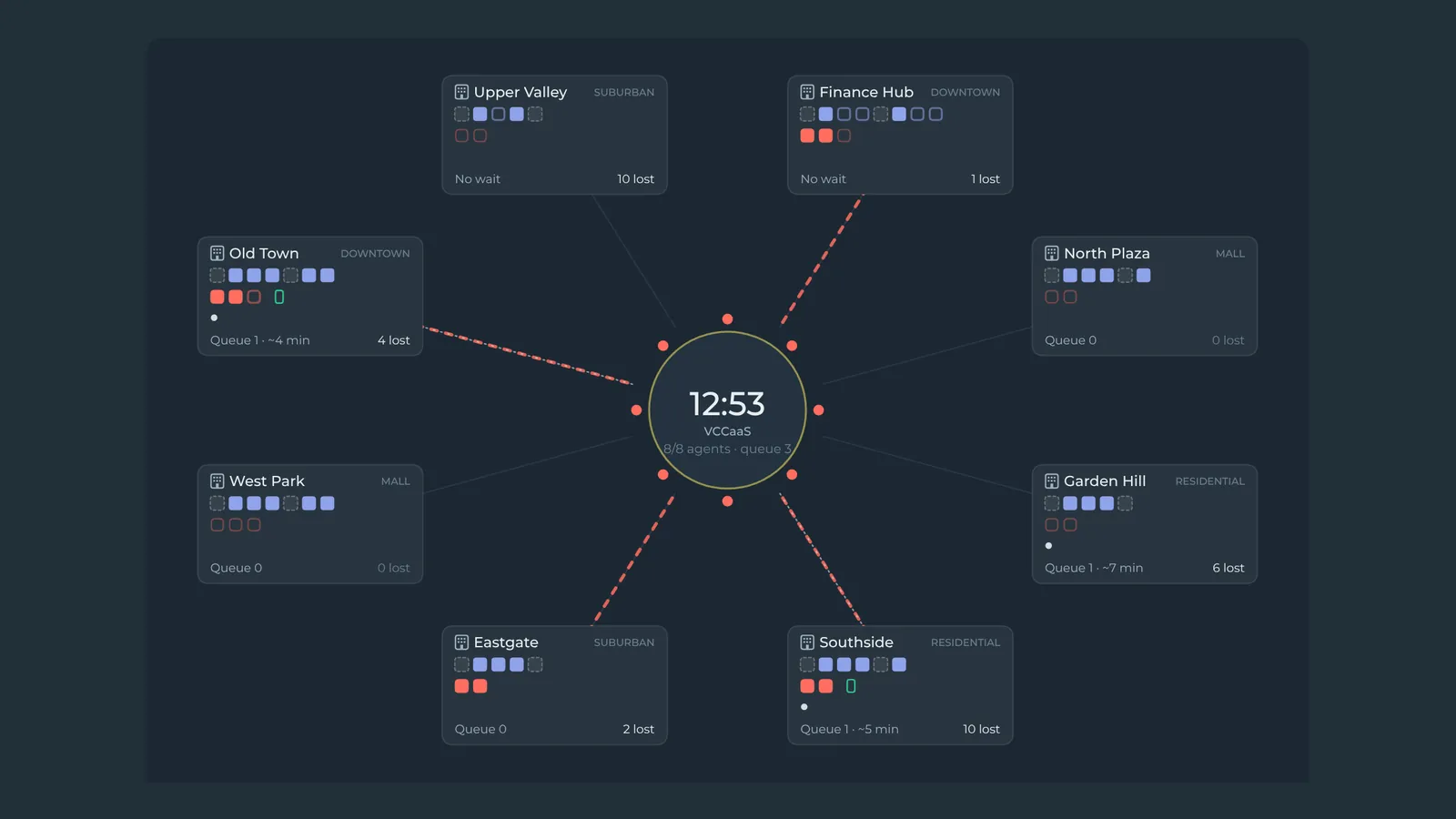
Photo source: Interactive Powers
The Branch With a Queue and the Branch Standing Empty Are the Same Network
An 8-branch network, one business day, 1,723 visits. 229 customers leave without being served: 13.3% of all visits. That same day, the in-person positions add up to 120 hours with nobody in front of them: 31% of installed capacity.
A queue and an empty seat, at the same time, in the same network.
Neither number is unusual on its own. Together they say something no branch report shows: the network doesn’t lack people, it can’t move them. A free advisor in one branch can’t serve the queue in the branch down the road. And each branch team is sized for a day that doesn’t exist: the average one.
Capacity is a property of the network, not of the branch.
What happens when capacity is shared
The in-person positions stay where they are. What is added is a remote team of 8 agents shared by all 8 branches, reached from a Video Kiosk in the branch or from the customer’s phone through a QR code. Same customers, same day:
| In-person only | + Video Kiosks | + QR | |
|---|---|---|---|
| Customers lost | 229 · 13.3% | 76 · 4.4% | 55 · 3.2% |
| Average wait | 1.5 min | 0.6 min | 0.6 min |
| Cost per customer served | 13.50 USD | 12.64 USD | 12.58 USD |
| Network result for the day | 7,281 USD | 9,279 USD | 9,666 USD |
The shared team is busy 66% of the day. The cost per customer served goes down, even though more customers are served, because a remote interaction costs less than an in-person one.
Dedicated or shared: the same headcount, two results
Take one busy branch inside that network, with 240 visits a day, Video Kiosks and QR.
- One remote agent of its own: the branch completes 91.7% of requested transactions, and the agent is busy 27% of the day.
- The 8-agent team shared across the network: that works out at 0.9 of an agent per branch on average, and the same branch completes 97.1%.
A dedicated agent waits for their own branch’s peak. A shared team follows the peak from branch to branch. That is the logic of a video contact center as a service (VCCaaS): the unit of capacity is the network, not the site.
Where this doesn’t help
In a network whose branches all peak at the same hour: sharing works because peaks don’t coincide. On anything that requires presence, such as cash, signatures and identity checks, which stays with the in-person positions. And where the remote agent lacks the same systems and authority to resolve as the branch, because then video only moves the queue somewhere else.
How these figures were produced
A discrete-event simulation of one business day across 8 branches with 49 in-person positions. The cost per interaction uses the reference rates in our report The CX Gap in Assisted Service: 13.50 USD in person and 7.16 USD remote. The 8-minute abandonment threshold in the ticket queue comes from the same report. The rest are working assumptions that change with each network’s data. The figures compare models; they are not a forecast.
💡 How many hours of empty positions does your network have today, while another branch has a queue?
👉🏻 We run this model with each network, on its own branches, hours and volumes. If you want to see yours, talk to our sales team.
Interactive Powers - Streamline your business communications