Served by Someone Who Isn't in the Branch — and Rated as If They Were
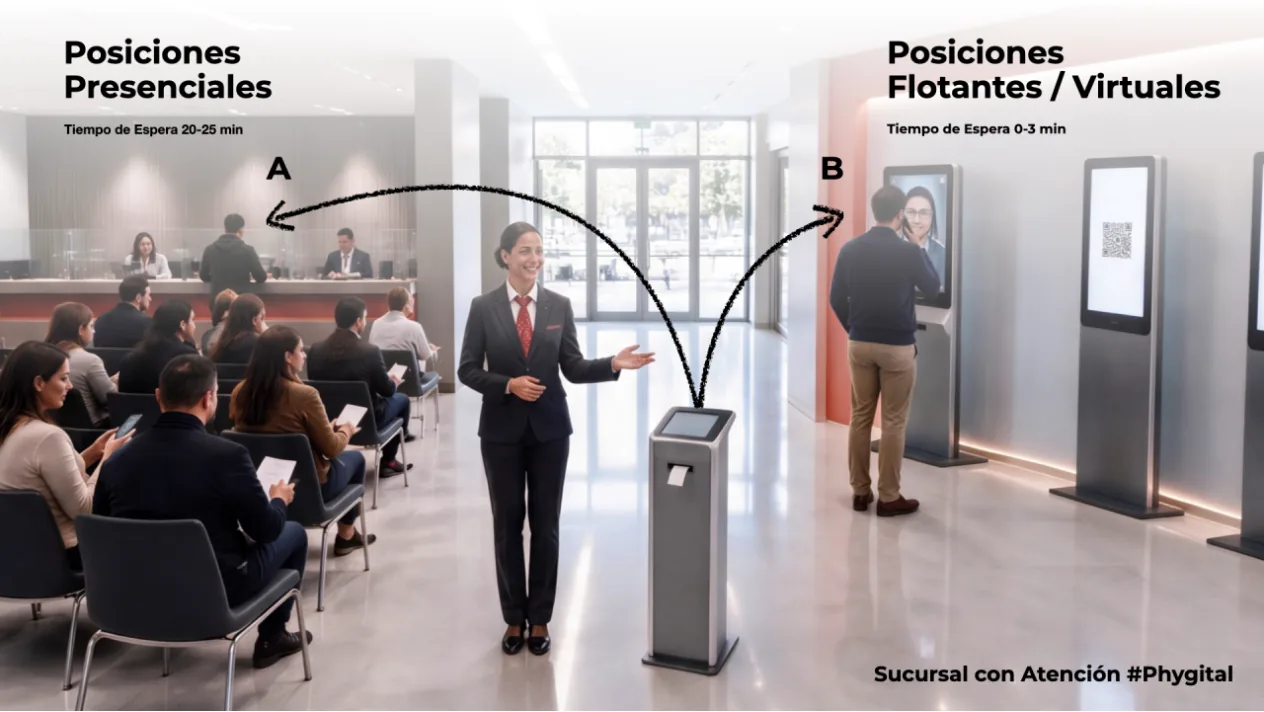
Photo source: Interactive Powers
Served by Someone Who Isn’t in the Branch — and Rated as If They Were
In a branch already running this way, the customer takes a ticket and chooses:
A. On-site position — 20 to 25 minutes’ wait. B. Floating or remote position (virtual) — 0 to 3 minutes.
Same operations, same resolution, same ownership of the case. Nobody steers the choice. The only variable that changes is where the advisor is sitting.
Self-service works. That is exactly why the counter got harder.
The customer walking through the door today is the one who already ruled out the digital channel. It’s the complex case, not the easy one. A decade of investment in digital channels and automation did what it promised — it absorbed the volume — but that success has a consequence that gets discussed far less: what reaches the branch now is what self-service can’t resolve. Amount, advice, documentation, exception. Or someone who needs to settle it face to face, with information they can verify in real time.
Their physical presence is an informed decision: they want to be served, not redirected. Handing them a cold self-service screen inside the branch, or a number to call, overrules their judgement. And there is an answer that costs even more, because it closes instead of deflecting: “if you don’t want to wait, come back another day.” That doesn’t lose a transaction — it loses the moment the customer was there, decided and available.
At the point of maximum friction you don’t need less technology. You need a different kind: the one that doesn’t replace the person, but gets them there sooner, at higher throughput and lower cost.
What the operation showed
- ✅ CSAT 9-10/10 — above any digital channel in the institution
- ✅ FCR 95% — on a par with the on-site position
- ✅ +50% service capacity — with no extra square metres and no extra desks
- ✅ Waiting time in remote positions consistently lower, with no visible breaks
The number that gives the other four their meaning isn’t quantitative: what customers reported was the perception of in-person service, not of an alternative channel.
Why customers take it naturally
Less waiting is the first thing they mention, and the first thing they reward — without exception. That it’s human is the second: a real person hears the whole case and takes it on, face to face, with no typing at them, no handoffs, and everything shown on screen. That’s why the score beats any digital channel — it isn’t competing in the same category.
And one technical condition makes it possible: the format. High-quality video, telepresence scale, framing at eye level. It isn’t what the customer values; it’s what makes the time saved and the human contact register as whole.
Why it outperforms the desk it replaces
| On-site position | Floating / remote position | |
|---|---|---|
| Wait to be served | 20-25 min | 0-3 min |
| Position during a break | Empty, in full view | Covered by the pool |
| Specialisation available | Branch generalist | Network specialist, AI-assisted |
| Peak absorption | Limited by the site | Shared across branches |
The SPLIT with VCCaaS technology doesn’t assign a position to a person: intelligent routing sends each connection to the first available agent in the pool, with audio confidentiality preserved at the customer’s side. With no fixed owner there is no dead time — and one of the most expensive scenes in the eyes of a waiting customer disappears: the executive who stands up because it’s their break. The technology doesn’t make people faster. It removes the structural gaps the on-site model can’t avoid.
The two ceilings of a branch: the peak and the specialist
A branch doesn’t have a volume problem, it has a concentration problem. Sizing for the peak means paying for overcapacity in the valley; sizing for the valley moves the cost to the customer as a queue. A shared pool dissolves the dilemma — it absorbs the overflow from a team shared across several branches, and in the valley that same team serves other demand.
Specialisation is the less visible restriction, and often the decisive one. A branch is staffed with generalists, and no network can keep an expert in every product in every site. The pool inverts that logic: it concentrates specialists for the whole network, with real-time AI assistance on the agent’s desktop. The remote agent ends up operating above the service ceiling of the counter — and that is where AI is most profitable: not serving the complex customer, but making the person who serves them better.
For a steering committee the headline is this: the branch is simultaneously the most expensive channel to operate and the most relevant to the brand. Optimising one axis always cost the other. This model holds both.
What this case does not yet prove: it is a single deployment, not a multi-sector rollout with differentiated results, and not a market sample. When comparable series exist across different business models, they will be published just as completely.
🤔 How are you covering the service peak in your branches today — and what does the customer pay for it in waiting time?
Interactive Powers - Streamline your business communications