Smart IVR is the Voice of AI Agents
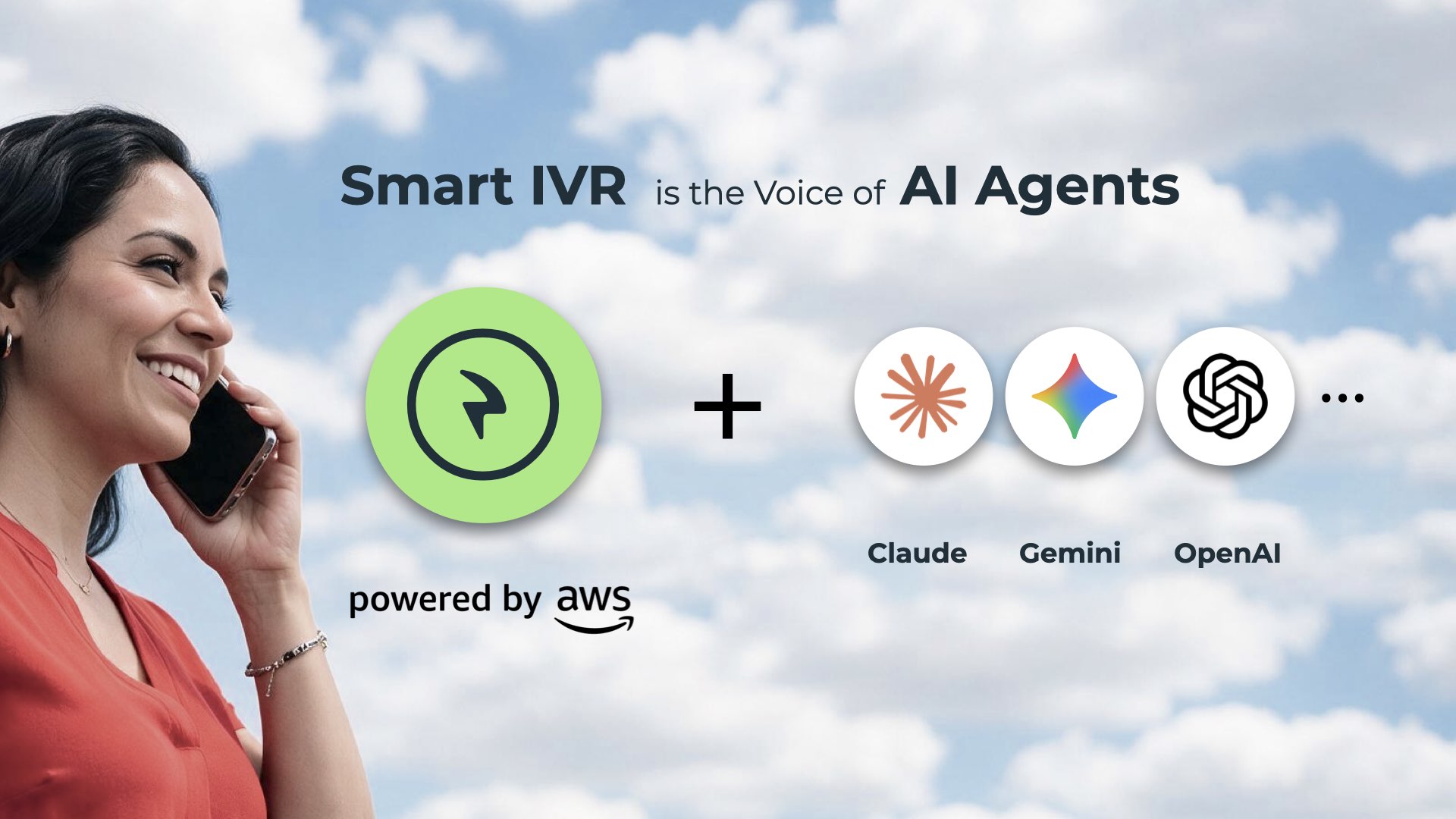
Photo source: Interactive Powers Creative Commons
AI Agent Gateway: your Agent handles the conversation, Smart IVR handles the phone
Smart IVR has always been built on a simple idea: give operators, integrators and enterprises a carrier-grade platform to run their own automated phone applications — instead of forcing them to code telephony from scratch.
For years, that meant VoiceXML. It is a solid W3C standard, and it still runs mission-critical services in banking, insurance, healthcare and public administration today. It is not going anywhere.
But the way conversations get designed has changed. Companies and technology providers no longer want to program a dialogue tree. They already have an AI Agent — built on Claude, OpenAI, Gemini or any other engine — that understands their business, their processes and their data.
What they are missing is not intelligence. It is the phone.
AI Agent Gateway is the Smart IVR dialogue interface that closes that gap.
Telephony is not an implementation detail
Putting an AI Agent on a phone line looks like an integration task. It isn’t. It’s a platform problem.
A production-grade phone service has to solve all of the following, at once and in real time:
- Carrier connectivity — SIP trunking, DID numbering, interconnection with the PBX or CCaaS already running in production.
- The full voice chain — TTS to speak, STT and ASR to listen, NLU where interpretation is needed, all within latencies the human ear tolerates.
- Call control — answer, hang up, hold, transfer to an extension, to a live agent or to an external number, conference, detect caller hang-up.
- Conversational behaviour — barge-in so the caller can interrupt, silence handling, retries, DTMF alongside speech.
- Recording and compliance — capture the interaction according to application context, with full traceability, in a certified environment.
- Scale and reliability — hundreds or thousands of concurrent calls, peaks included, without degrading service.
Building that from scratch is a telecom project, not an AI project. In practice, it is what separates an impressive pilot from a service that survives contact with real callers.
Your Agent only has to hold the conversation
AI Agent Gateway flips the division of labour.
Smart IVR provides the telephony: standard connectivity, speech engines, call control, recording, multi-node scalability. Your Agent provides the one thing nobody else can — business judgement.
Between the two sits a dialogue interface that is already specified and directly interpretable by AI engines. The Agent reads what is happening on the call and responds with what should happen next. No proprietary SDK to learn, no voice stack to maintain, no telephony infrastructure to operate.
In practice, your Agent can:
- Speak and listen in any language and voice, using advanced TTS/STT/ASR engines already integrated and optimised — Google, Azure, AWS, Deepgram, Nuance, Verbio and others.
- Be interrupted naturally through barge-in, instead of reciting prompts the caller has stopped listening to.
- Read the full call context — who is calling, which number they dialled, what routing data came with the call, what the caller just said.
- Exercise call control — transfer to a live agent, an internal extension or an external number; hand off to the CCaaS when the conversation calls for it.
- Record the conversation according to the rules of the service.
- Coexist with what already exists — DTMF, pre-recorded prompts, legacy VoiceXML applications. Nothing has to be torn down to get started.
An addition to Smart IVR, not a replacement
This is the part that matters most to existing customers.
Smart IVR remains the same carrier-grade platform running critical services in production today. AI Agent Gateway sits alongside VoiceXML rather than replacing it. A single node can serve established VXML applications and, on whichever number or menu option you choose, hand the call over to an AI Agent.
That makes something possible which is rare in this market: adopting generative AI in stages, measuring the result at each step, without putting a working phone service at risk.
Scale, because it is still an IVR
An Agent that handles ten calls well and collapses on the hundredth is not a service. It is a demo.
Smart IVR was designed as a carrier-grade IVR platform, and that heritage is exactly what makes this model viable: multi-node architecture, clusters deployed on AWS, SIP routing in front, and dedicated ITSM monitoring by region, node and service. Adding capacity means adding nodes — from tens to hundreds of concurrent channels — without redesigning the application.
Underneath sits our managed CPaaS: an AWS environment covered by ISO 27001, ISO 27017 and ISO 27018 certifications, a 99.99% uptime target, and full operational traceability. That is the difference between “the Agent answers the phone” and “the Agent is the company’s phone service”.
For partners: your engine, our voice
If your company builds AI Agents for third parties — as several of our partners already do — the read is direct.
You keep your product, your model, your intellectual property and your customer relationship. We provide, under your project, the complete telephony layer: SIP, speech, call control, scaling and cloud operations. Your Agent moves from being a chat channel to also being a voice channel, in weeks, without opening a telecom line of business.
This model is already running in real projects across healthcare, banking, insurance and the public sector.
Start with a call
In most industries, the phone is still where the conversations that matter actually happen: the medical appointment, the insurance claim, the urgent incident, the request that cannot wait for an email reply.
With AI Agent Gateway, that channel stops being a barrier to entry for AI and becomes a natural extension of the Agent you have already built.
Smart IVR is the voice of AI Agents.
Want to review the interface specification or test it with your own Agent? Talk to our team or request a demo.
Interactive Powers - Streamline your business communications