We Don't Want More Apps
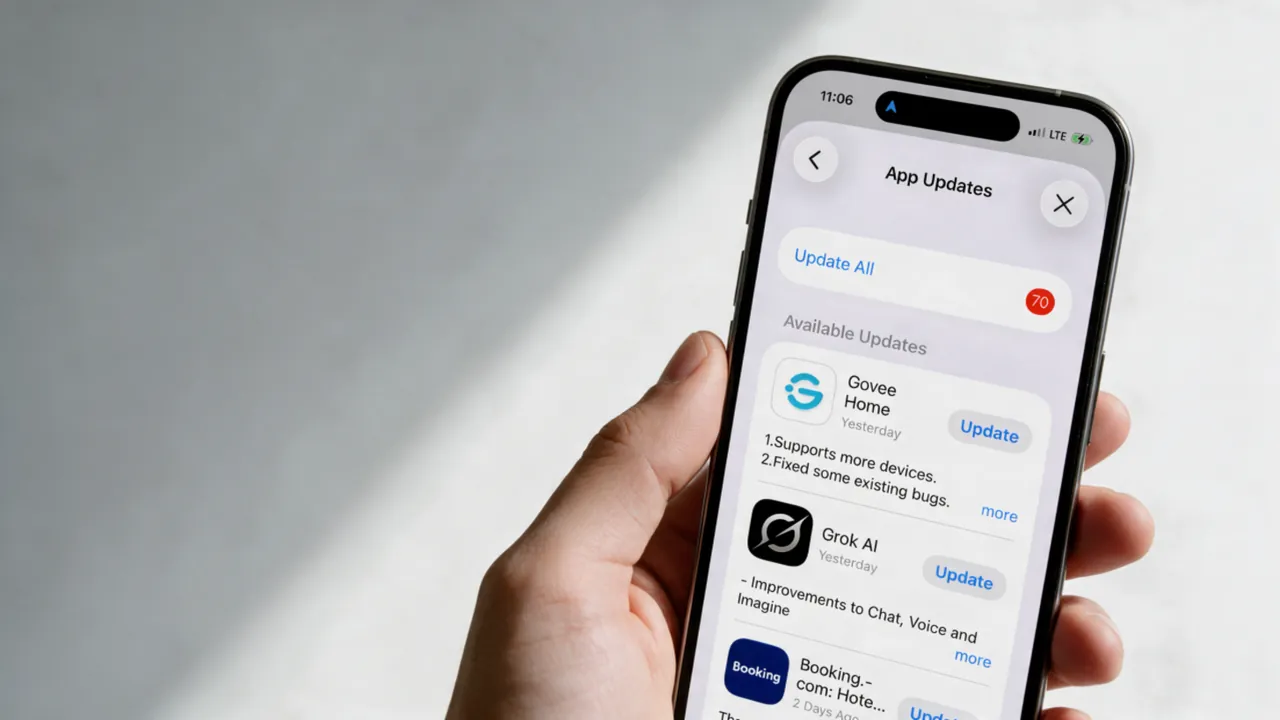
Photo source: Interactive Powers
We Don’t Want More Apps
I open the App Store and a red number is waiting for me: 70 pending updates.
I didn’t ask for them. I don’t know what they change. I couldn’t review them one by one even if I wanted to. And it hasn’t been that long since the last time — a week, maybe two. Think about it for a moment and it’s absurd.
Several of them will bring new terms I’ll have to accept to keep using a service I was already using. Your number is probably red too.
It isn’t a feeling. It’s a trend
The data has pointed in the same direction for years:
- 📉 51% of US smartphone users download no new apps in a typical month.¹
- 📉 80% of mobile time is spent in just five apps.²
The phone is full, but attention lives in a handful of applications. Why? Because installing has become a burden.
For the user: from revolution to maintenance
Fifteen years ago, installing an app was a small celebration. “There’s an app for that” was a promise of convenience. Today that promise has been inverted. The user no longer manages services — they manage, or rather put up with, a software inventory:
- → Updating without knowing what changes.
- → Accepting terms so as not to lose the service.
- → Muting notifications, including the important ones.
- → Granting permissions out of fatigue, not conviction.
- → Spreading their data across dozens of accounts.
- → Deleting apps or photos to free up space.
Installing is no longer opening a door. It’s signing up for an open-ended maintenance relationship.
And the problem doesn’t end with the user.
For the business: an obstacle course
The model was designed around the stores, which control distribution and charge commissions of up to 30%. For whoever publishes an app, that means:
- → Reviews they don’t control, on every version.
- → Privacy rules that change without notice.
- → Mandatory adaptation to every new OS release.
- → Security patches on two platforms.
- → Two teams: iOS and Android.
A lot of cost just to stay in the same place. The user doesn’t want to maintain the app. Neither does the business.
The consequence: the customer goes somewhere else
The customer doesn’t stop needing your company. They look for another route — and they almost always find it in the apps they already have: WhatsApp, Instagram, X and, increasingly, their AI assistant.
For them it’s logical. For the business it’s delicate: the relationship with its customer ends up living on someone else’s platform, with someone else’s rules, fees and changes of terms. You escape one dependency only to fall into another.
What’s needed is a route of your own that doesn’t require installing anything.
The alternative: the web that behaves like an app
That route exists: PWAs (Progressive Web Apps). A PWA opens from a link or a QR code, works on any phone and, if the user wants, can be added to the home screen like any app.
For the user:
- ✅ Nothing to install to get started.
- ✅ No updates: always the latest version.
- ✅ Almost no weight — Starbucks’ PWA is 233 KB, against 148 MB for its iOS app.³
- ✅ Permissions only when they’re used.
- ✅ Notifications only if the user accepts them.
For the business:
- ✅ One build for every device.
- ✅ Instant publishing, no store review.
- ✅ An owned channel, with no intermediary commissions.
Their limits, honestly
PWAs aren’t perfect. On iPhone they had limitations for years. In 2024, Apple announced it would remove home-screen web apps in the European Union, and reversed the decision weeks later after criticism from developers and the European Commission.
That episode says a lot: when a technology lets you do without the store, the store doesn’t promote it.
Nor should everything be a PWA. Your main bank, your messaging, your music justify a native app: they are the five apps the user does maintain. The rest has no reason to demand a commitment the user doesn’t want to make:
- → The one-off enquiry.
- → The booking.
- → Customer service.
- → The administrative procedure.
What comes next
The current model won’t last. AI points towards mobile systems where the interface is generated for the task, not for the installed app — adaptive applications that appear when needed and disappear afterwards.
Many of us want that. But it has a trade-off: we would swap dependence on the stores for dependence on AI. The question will be whether the user stays in control of what that AI does on their behalf.
What we do know is that this future is built on the web. An assistant can open a link and complete a web service. It can’t get into an app nobody has installed.
That’s why the PWA isn’t just the answer to today’s saturation. It’s the most sensible way to be ready for what comes next.
The real question
For a decade the question was: do we have an app? Today it’s a different one: how much do we ask of the customer before we can serve them?
Every download, every update and every “I accept the new terms” is friction the customer has already decided not to pay.
🤔 Do you know how many customers never got served because you asked them to install your app?
¹ comScore, U.S. Mobile App Report (2017). ² Forrester Research (2015). ³ Starbucks PWA case study (NearForm).
Interactive Powers - Streamline your business communications