Good for the Business, the Employee and the Customer: Breaking the Zero-Sum Game of Service
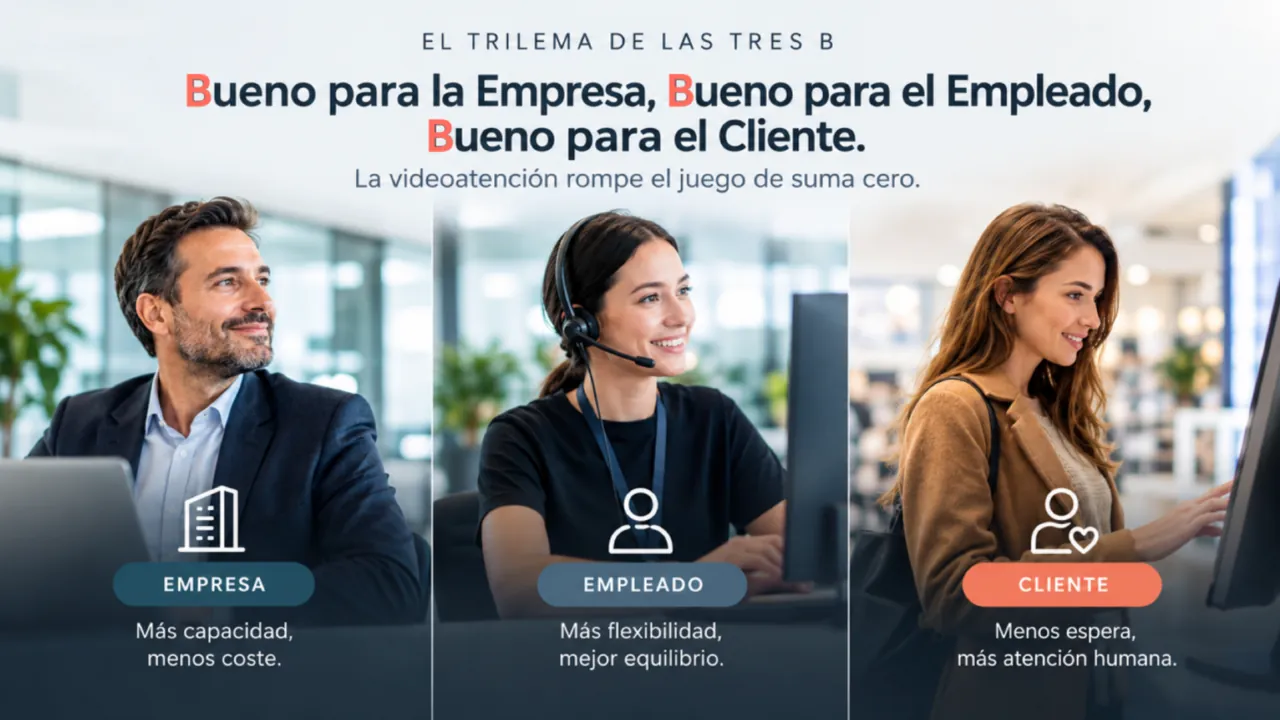
Photo source: Interactive Powers
Good for the Business, the Employee and the Customer: Breaking the Zero-Sum Game of Service
Customer service has three actors: 🏢 the business, 👩💻 the employee and 🙋 the customer.
For years, improving things for one of them meant that someone else paid the bill. Try it with any process and you’ll see it almost always holds — even with AI or digital tools, someone loses:
- → If the business wanted to cut costs, it cut capacity or quality.
- → If it protected the employee, it lost availability or flexibility.
- → If it wanted to serve the customer better, structural costs went up.
It was always a zero-sum game. Until we stopped thinking of service as a fixed, physical position.
The change is remote video
Video service separates two things that were always bound together: where the customer is, and where the person serving them is.
The agent can be in a contact center or in another branch, while the customer is in a branch, at a kiosk, in a store, on their phone, or anywhere else. In-person capacity is no longer anchored. Now it is shared — and that’s where all three benefits appear.
- 1️⃣ For the business → more capacity and lower operating costs, with no extra floor space. The same team can serve different locations depending on where demand appears.
- 2️⃣ For the employee → steadier workload, better recognition and more flexibility. Cases reach whoever is available, and breaks can be covered by a remote colleague.
- 3️⃣ For the customer → less waiting, without losing human service. No travelling, nothing to learn, no queue to get a person in front of them.
What it looks like in practice
In a reference deployment where customers could choose between in-person service and video service, these were the measured and compared results:
- ✅ CSAT 9-10/10, measured in real time after each video interaction
- ✅ FCR 95%, on a par with in-person service
- ✅ Waiting time of 0-3 minutes, compared with 20-25 minutes before
- ✅ +50% operating capacity
- ✅ Fixed costs unchanged, variable costs down 50%
These are real figures from one specific deployment, not a universal promise. But they show something that no other channel — digital or in person — had managed: all three actors gain at the same time.
Video service doesn’t remove the human. It removes the need for the human to be physically where the customer is.
And that changes the economics of direct service:
- ✅ Fewer idle, anchored positions and less lost working time.
- ✅ More shared capacity, without physical borders or local opening hours.
- ✅ Higher performance and better use of resources.
- ✅ Shorter waits for everyone.
Human service is where critical value is delivered. That is the real triple benefit: the business wins, the employee wins, the customer wins.
And that may be the biggest difference between digitalizing service coldly and redesigning it.
🤔 Which of the three is paying the bill in your service model today?
Interactive Powers - Streamline your business communications